The Write Time

Our life experiences are unique, and writing can help us make sense of them. This is an invitation to look within, reflect on the events that shape us, and perhaps begin writing your own story. After all, your life is worth recording.

Introduction

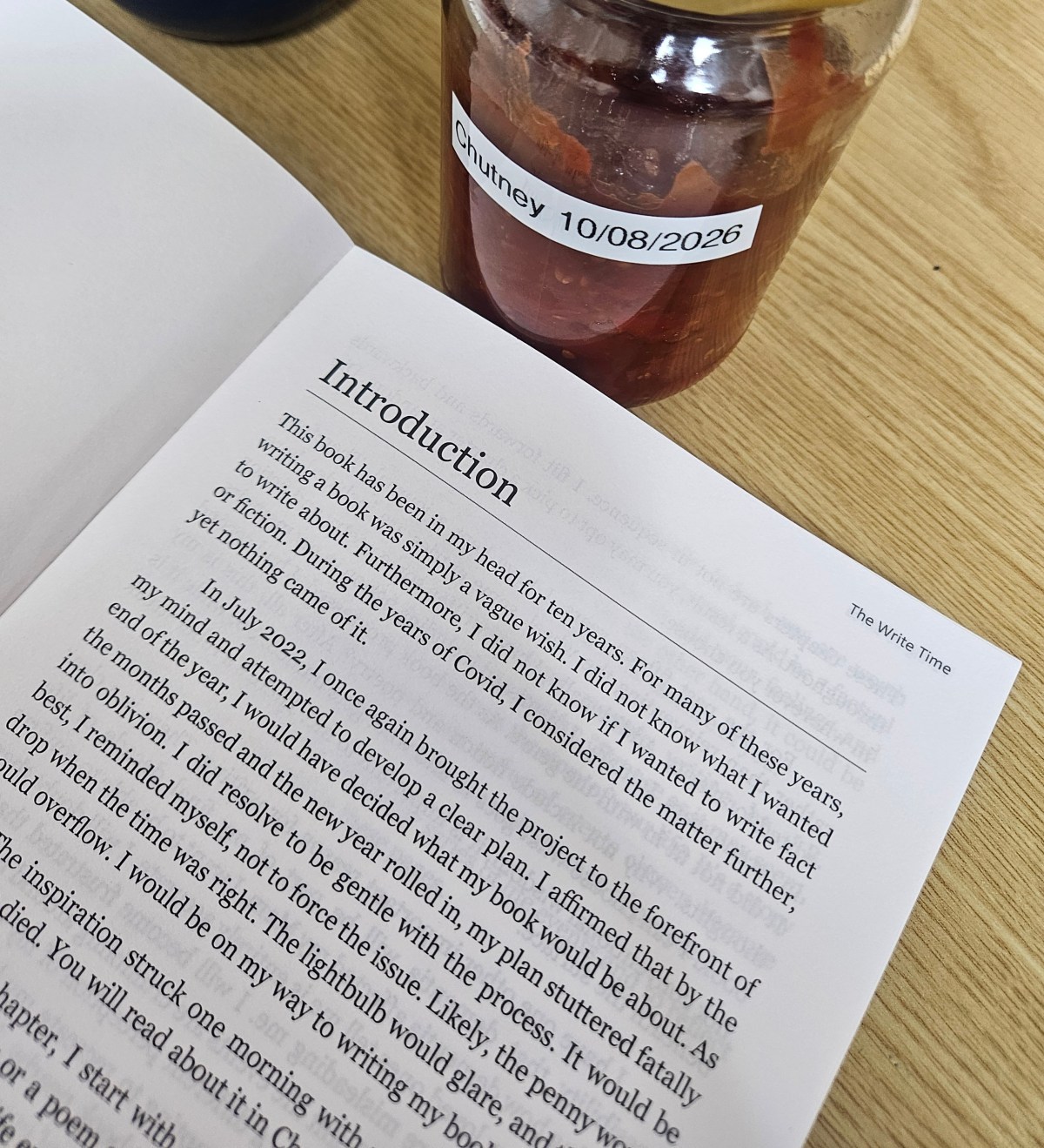
This book has been in my head for ten years. For many of these years, writing a book was simply a vague wish. I did not know what I wanted to write about. Furthermore, I did not know if I wanted to write fact or fiction. During the years of Covid, I considered the matter further, yet nothing came of it.

In July 2022, I once again brought the project to the forefront of my mind and attempted to develop a clear plan. I affirmed that, by the end of the year, I would have decided what my book would be about. As the months passed and the new year rolled in, my plan stuttered fatally into oblivion. I did resolve to be gentle with the process. It would be best, I reminded myself, not to force the issue. Likely, the penny would drop when the time was right. The lightbulb would glare, and the bath would overflow. I would be on my way to writing my book.

The inspiration struck one morning with my Mam, two weeks before she died. You will read about it in Chapter 1.

In each chapter, I start with a few lines, sometimes an entire verse, from a song or a poem and offer my thoughts as I attempt to fit the lyrics into my life experience. As you read further, you will see my catchphrase regularly: For What It’s Worth. I offer these insights based on my values, thoughts and emotions. In this way, the book is largely autobiographical.
My stories, memories and experiences are laid before you throughout. There are sixty-five episodes in my life story, exactly matching my age. They cover my childhood, school, college, work, family and retirement years. Within these pages are my selected memories, but you will also discover my strengths, frailties, fears and hopes. These chapters are not in sequence. I flit forwards and backwards throughout. As a result, you may opt to pick a chapter at random. Dip in wherever you choose.

For the past fifteen years, I have kept a journal. Therefore, rather than reinventing the wheel, some entries are included here, edited for clarity. Additionally, I have written some poetry and fiction in recent years. Initially, I dismissed including fiction in my memoir. It did not fit in with the genre. As the book progressed, I had second thoughts. Why not include fiction and poetry? After all, this is my book. I can choose what goes in and what gets binned. So, while it is not conventional wisdom, it is important to me. There’s a rebel streak beneath the surface.

I have one other important reason for writing. There is a clear possibility that dementia will be part of my final decade of life. Knowing how dementia affected my Mam, I want to be able to confirm that what my loved ones tell me is entirely accurate. I will doubt them and think they are misleading me. I will become frustrated that my recollections of significant life events are crumbling around me. I will move beyond frustration to a different perception of my world. I will see loved ones and carers attempting to recreate my broken head. I have given instructions to have this book nearby, in the hope that I will recognise myself. When my memory of events is gone, I may still recognise myself in my turn of phrase and strange wit. If I am wrong, I will not know I’m wrong, so it does not matter at all. The grander scheme of things will continue in my absence of mind.

Throughout this book, there are references encouraging you to write. Your life experiences are unique. I urge you to put your thoughts on paper, whether privately or for publication. Do not judge your efforts harshly. I can offer this insight: the process of writing is cathartic. By reading my story, you can look within yourself. I promise you that the journey is worthwhile. Indeed, you are worth it!

You can start by keeping a journal. Your journal could be a factual account of events, and you may decide to add your feelings and emotions, the ups and downs of life. On the other hand, it could be fiction, poetry or drawings. Your journal is the essence of you.

A recent interview concerning memoir writing by J. R. Moehringer brought this interesting insight:

“Strange as it may seem, memoir is not about you. It’s not even the story of your life. It’s a story carved from your life, a particular series of events chosen because they have the greatest resonance for the widest range of people.”

I invite you into my particular series of life events and to reflect upon the issues that arise within these pages.

For What It’s Worth, it’s a wonderful life.
Chapter 1: Seize The Day

A morning with my frail 91-year-old mam, music playing in my ears, became the unexpected starting point for a book about life, self-love, resilience and the importance of seizing the day.

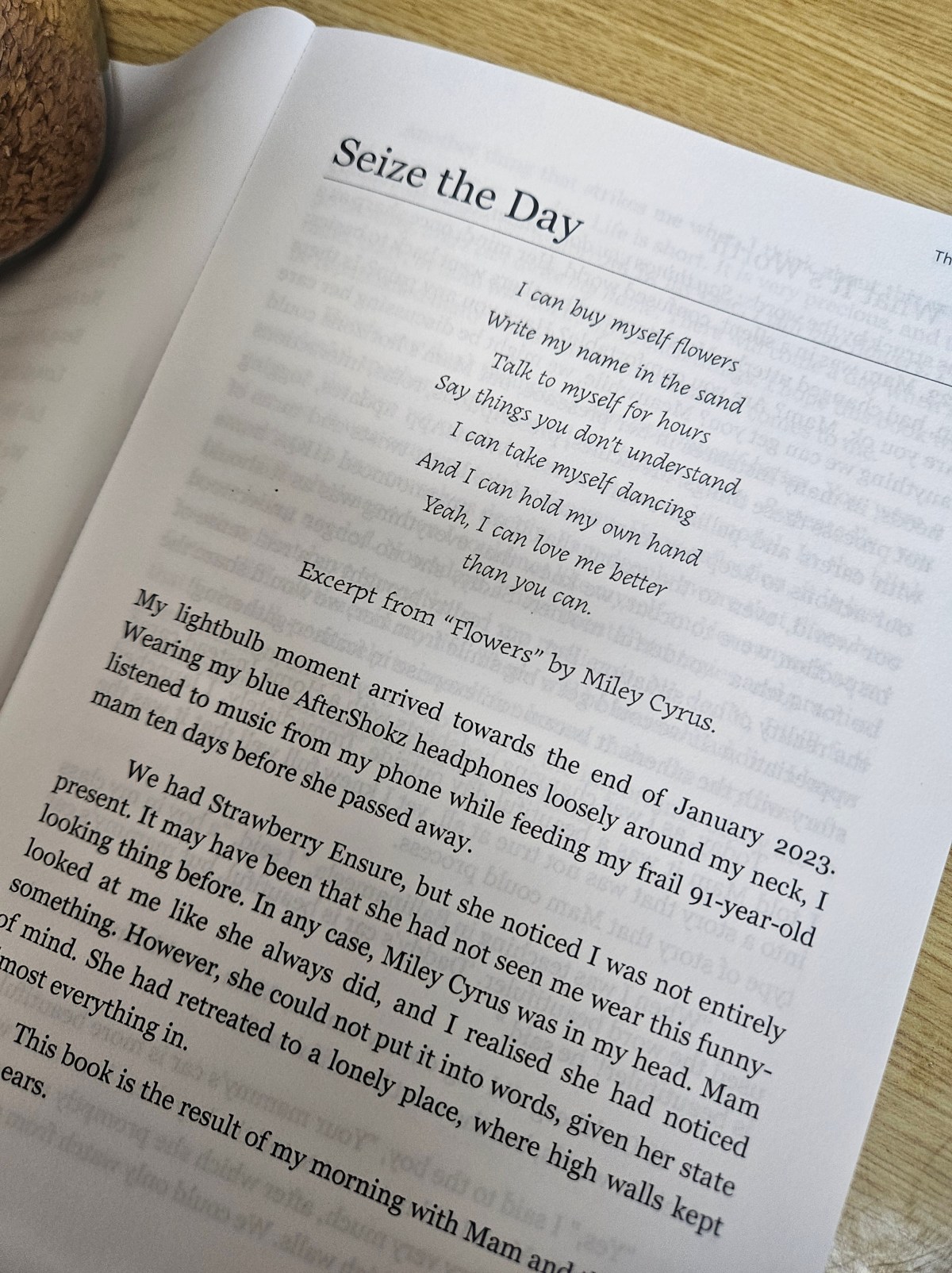
I can buy myself flowers
Write my name in the sand
Talk to myself for hours
Say things you don't understand
I can take myself dancing
And I can hold my own hand
Yeah, I can love me better
than you can.

Excerpt from “Flowers” by Miley Cyrus (January 2023).


My lightbulb moment arrived towards the end of January 2023. Wearing my blue AfterShokz headphones loosely around my neck, I listened to music from my phone while feeding my frail 91-year-old mam ten days before she passed away.

We had Strawberry Ensure, but she noticed I was not entirely present. It may have been that she had not seen me wear this funny-looking thing before. In any case, Miley Cyrus was in my head.

Mam looked at me like she always did, and I realised she had noticed something. However, she could not put it into words, given her state of mind. She had retreated to a lonely place, where high walls kept almost everything in.

This book is the result of my morning with Mam and the music in my ears.

For What It’s Worth

Firstly, I was struck by the words: Say things you don’t understand. By January 2023, Mam was in a silent, confused world. Her mind, once sharp as a pin, had changed utterly. My sisters and brothers went back to basics: Are you ok, Mam? Are you comfortable? Have you any pain? Is there anything we can get you?

Meanwhile, we might be discussing her care needs, in many instances in her presence, but Mam’s horizons could not process these things. Medicines, prescriptions, rotas, interactions with carers and palliative care nurses, WhatsApp updates, logging our actions to keep our team aware of the latest twists and turns of our world, even to the extent that if an unannounced HIQA home inspection were to occur, we knew that everything was as it should be for such a wonderful mother. Sadly, she no longer
understood the reality of her situation. But, our reality brought us a real sense of appreciation.

If we could get a big smile from her, we would share the story with the others. It became an exercise in feather-gathering! Today, as I was changing bedsheets with a Home Instead carer, I told Mam it was a
beautiful day outside. Immediately, I launched into a story that was not true at all, yet I knew full well that it was the type of story that Mam could process.

“When I was teaching in Ballinameela,” I said, “a boy in my class used the word
beautifuler. ‘Daddy’s car is beautiful, but mammy’s car is beautifuler!’, he said.”
If Carlsberg did big cheesy smiles, Mam would have won the prize! No words, but the most beautiful smile. “Yes,” I said to the boy, “Your mammy’s car is more beautiful.” I mentioned to MamI did not want to tell the boy there is no such word. Mam liked this story very much, after which she promptly returned to her mind surrounded by high walls. We could only watch from outside.

Another thing that strikes me when I think about this verse is that we must seize the
day. Life is short. It is very precious, and there are no guarantees for tomorrow. In my case, I can buy flowers. I can take go dancing, and I can write my name. There will come a day when my mind, body, or both will not be up to such things. I hope this book will be republished many
times before this situation comes to me.

Here’s my final thought, for what it’s worth: I can love myself better. You were a
wonderful mother. You showed us how to love. Repeatedly, you gave us the love we needed. You were our role model. In the blink of an eye, it was our turn to care for you. Upon reflection, it is just as important to love ourselves. I am deeply aware that there have been difficult times when I could not like myself and love myself as my inner being needed.

Nowadays, I have mental strategies and practical routines that have strengthened my resilience. No doubt, I will face further difficult times in my life. There will be tears ahead, but I know that I can talk positively to myself for hours, make the very best of a given situation, and have a deep sense of the importance of my life to me and others. Happily, I can hold my own hand.

Over To You

  • What insights do you have about yourself or those close to you?
  • What do the words of the verse mean for you?
  • What is your story? Could you write it?
  • What music resonates with you?
  • Consider writing your book. Is this an impossible task? This question is repeated at the end of the final chapter. Between this and then, do ponder on filling your blank
    pages.